 Swiftlisted
How to Price Items Across Marketplaces to Guarantee Your Profit After Fees
When you crosslist inventory across multiple marketplaces, setting a single price everywhere will leave you with unpredictable profits. Every platform calculates cuts differently. Some charge sellers a portion of the entire buyer payment, including postage and sales tax, while others charge nothing to the seller and place fees entirely on the buyer. To maintain a consistent net payout on every item, you must adjust your listing prices to account for how each venue calculates its charges.
Establish Your Net Profit Baseline Before Listing
Before looking at any platform fee rules, determine the exact takeaway amount you require from an item. Your net profit baseline is the money left over after covering what you originally paid for stock and any direct out-of-pocket costs required to dispatch the package.
Start by adding your sourcing cost to the actual postage expense you will pay out of your own bank account if shipping is not prepaid. Next, add the minimum reward amount you expect to earn for finding, storing, and handling the item. This total represents your payout target. Your goal on every marketplace is to work backwards from this baseline number so that after all platform deductions are subtracted, the remaining funds meet or exceed your target.
- Sourcing cost: What you spent to buy or acquire the inventory item.
- Direct postage cost: What you pay out of pocket to ship the item if you cover carriage.
- Target profit: The clear margin you intend to keep as business revenue.
Understand What Each Marketplace Charges Fees On
Platforms differ fundamentally in who pays each charge and what portion of the transaction is assessed. Calculating your final price requires knowing whether fees apply to the item price alone, the item plus shipping, or the total order value including tax.
On eBay in the United States, Australia, and Canada, sellers pay a final value fee and a per-order fee assessed on the whole order, which includes the item price, shipping charges, and any sales tax collected. In contrast, eBay listings in the United Kingdom and Germany assess a flat final value fee, a per-order fee, and a regulatory operating fee on the item price and buyer shipping, plus local tax charged directly on those fees. Buyers in the UK and Australia pay a separate Buyer Protection fee on the item price.
Etsy charges sellers a flat listing fee, a transaction fee on the item price and buyer shipping, and a payment processing fee on the whole order, alongside potential offsite ad fees and regional taxes on fees. Shopify charges payment processing fees, international card fees, currency conversion fees, or third-party transaction fees calculated across the total order. Whatnot charges a seller commission on the item price, combined with payment processing on the whole order in the US and Canada, or on the item and shipping in the UK, Australia, and Europe.
If a specific marketplace detail or regional policy is not covered by these core rules, fee mechanics can vary depending on category or opt-in status, so always review the marketplace's own fee page to confirm specific policies.
Account for Buyer-Paid Fees and Platform Shipping Labels
Some marketplaces shift the main cost burden to the buyer or handle shipping directly through their own system. Recognizing these distinctions prevents you from overpricing or underpricing when you crosslist across different venues.
Vinted charges sellers no selling fee in any supported region. Instead, buyers pay a Vinted fee based on the item price, and buyers purchase shipping labels directly through the marketplace without fees assessed on that shipping. On Poshmark in the US and Canada, buyers also purchase shipping labels directly from the venue with no fee attached. Sellers pay a single Poshmark fee on the item price only, though US sellers may opt into seller-paid shipping discounts or incur overweight label fees, and Canadian sellers pay tax on the venue fee.
Vestiaire Collective operates similarly, with buyers purchasing shipping labels directly. Sellers pay a selling fee and payment processing fee calculated solely on the item price. On Mercari in the US, the seller pays a selling fee on the item price and shipping, while the buyer pays a Buyer Protection fee on that same total.
Depop varies by location. Sellers in the US, UK, and Australia pay no basic selling fee, while buyers pay a marketplace fee on the item price. However, Depop sellers in Europe and Canada pay a selling fee and a PayPal fee based on the item price and buyer shipping. US sellers pay payment processing on the whole order, while UK and Australian sellers pay processing on the item price and buyer shipping.
Grailed assesses seller commission on either the item price alone or the item plus buyer shipping, alongside a payment processing fee on the full order. On Facebook Marketplace in the US, sellers pay a selling fee assessed on the entire order value.
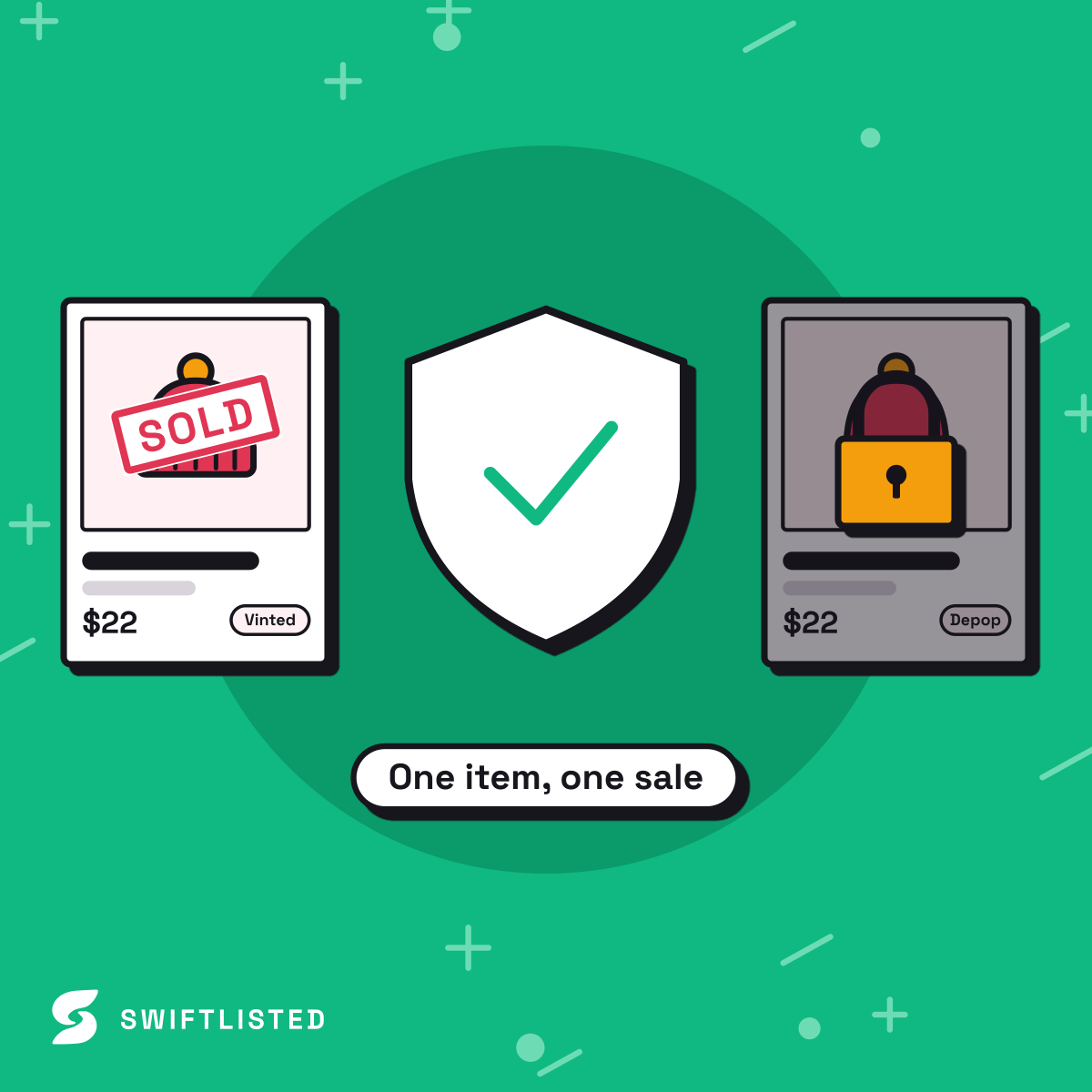
Build a Simple Step-by-Step Pricing Formula
To price your inventory consistently across every venue, follow a structured process for every item before publishing your listings.
First, write down your baseline payout requirement. Second, check the fee structure for your target marketplace to see whether fees apply to the item alone or include shipping and tax. Third, calculate the necessary gross listing price so that once the venue deducts its flat charges and variable cuts, your net remittance matches your baseline.
When crosslisting, adjust your price on each venue independently rather than copying one arbitrary figure everywhere. If a platform charges fees on buyer shipping, incorporate that cost into your item price or shipping charge. If a platform relies on buyer-paid fees, you can often set a lower listing price while keeping the exact same net profit.
Use a Dedicated Fee Calculator to Save Time
Working out complex multi-fee structures by hand for every item is slow and prone to errors. Using a dedicated fee calculator simplifies your routine and ensures your margins remain accurate across every country you sell in.
Swiftlisted provides free online fee calculator tools requiring no sign-up. There is a specific fee calculator available for each supported marketplace, featuring a dedicated selection button for every country. When you enter your proposed sale price, shipping costs, and inventory acquisition cost, the fee calculator automatically breaks down every individual fee and reveals your exact final payout.
To compare payout values across multiple venues simultaneously, use the single multi-platform comparison fee calculator page. It runs the exact same sale scenario through every available marketplace in a given country, allowing you to instantly set the perfect price for every platform when you crosslist.
Common questions
- Should I charge the exact same item price on every marketplace?
- No. Because each marketplace assesses fees differently—some taking fees from the whole order and others charging zero seller fees—setting identical prices means your net profit will vary wildly. Adjust your item price per venue so your final payout stays consistent.
- How do buyer-paid fees impact my listing price?
- Platforms that charge protection or marketplace fees directly to the buyer increase the total cost the buyer sees at checkout. You can often set a slightly lower listing price on these venues while taking home the same net profit as a higher-priced listing on a seller-fee platform.
- What is the fastest way to check fees for different countries?
- Use a free online fee calculator that includes regional toggle buttons. Swiftlisted provides a fee calculator for every major marketplace with country-specific rules, along with a venue comparison calculator to see all regional payouts side by side.
- Why do some platforms charge fees on shipping amounts?
- Marketplaces charging fees on shipping do so to prevent sellers from listing items for negligible prices with inflated shipping charges. When pricing on these platforms, remember that any postage paid by the buyer increases the platform fee assessed on the order.
Run the numbers on your sale
Free fee calculators for 11 marketplaces, by country: every fee, and what you keep.
Open the fee calculators