 Swiftlisted
Delisting Sold Items: Why a Sold Item Has to Come Down Everywhere, Fast
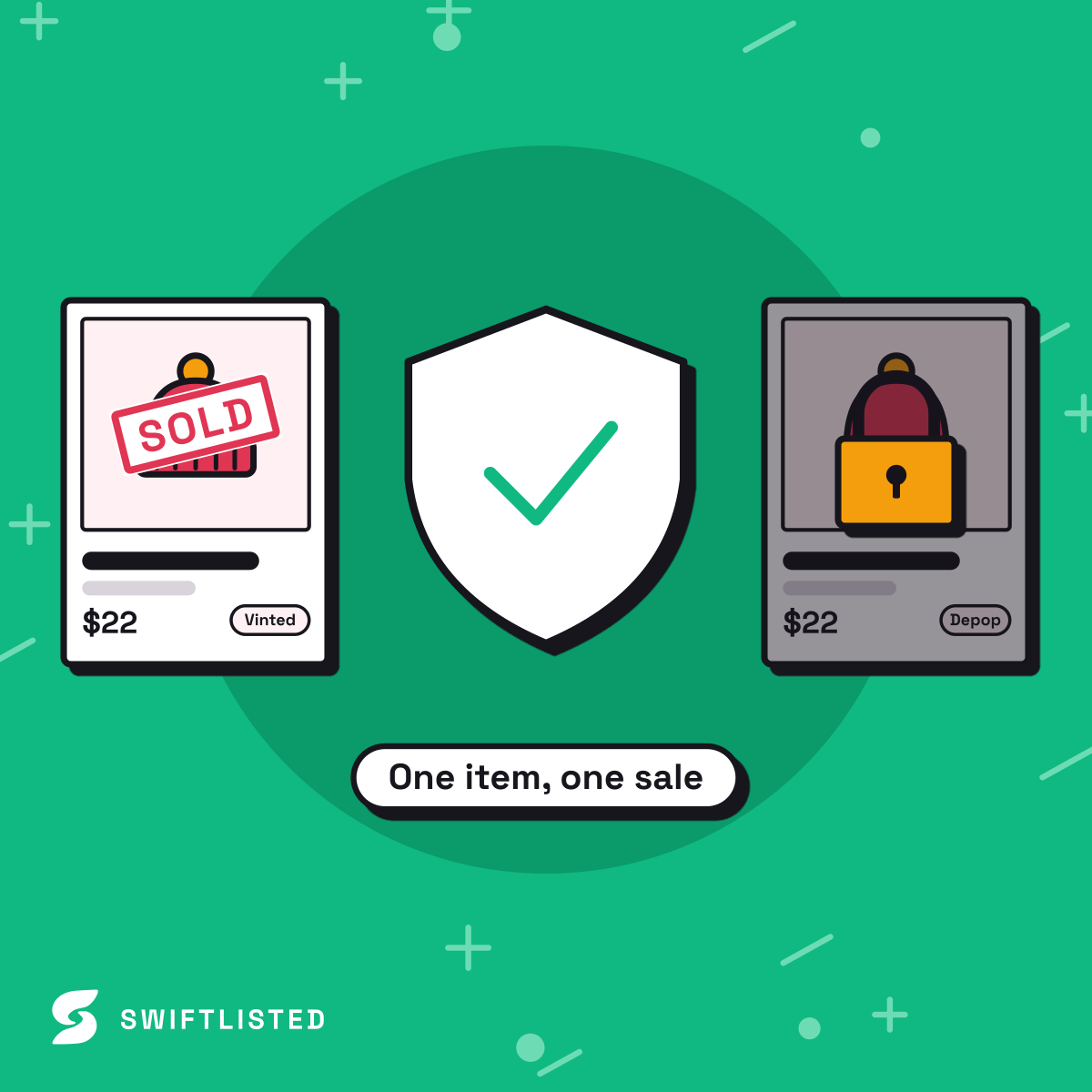
A sold item has to come down from every other marketplace before anyone else can buy it, and the gap between the sale and the delist is where double-sales happen. The gap is set by how each marketplace reports sales, how often your tool checks, and whether you are watching. Shorten it by knowing which marketplaces tell you instantly and which you have to wait for, by checking the sale yourself where it matters, and by never assuming a delist worked until you have seen it.
Why the gap exists
When you crosslist, the same item sits on several shops at once. The moment it sells on one of them, the copies elsewhere are a promise you cannot keep. Whether you can keep that promise depends on how quickly each marketplace tells you a sale has happened.
Marketplaces do not all work the same way. Some send an order notification the moment it is placed. Others have no push notification you can rely on, so a tool has to check your shop on a schedule. A scheduled check means there is always a window, sometimes minutes and occasionally longer, where the item is sold on one shop and still live on another. Plan for that window rather than assuming it away.
- Instant-notification marketplaces: order placed is reported close to immediately, so the gap is small.
- Scheduled-check marketplaces: a tool looks at your shop on a timer, so the gap is as long as the interval plus processing.
- Your own vigilance: a manual check of the other shops during the gap is the only thing that closes it when automation is slow or signed out.
Which marketplaces are fast and which are slow
Swiftlisted connects to eBay and Shopify through their official APIs, and eBay and Shopify notify it when an order is placed, so those sales are picked up almost immediately. Depop, Etsy, Facebook Marketplace, Grailed, Vestiaire Collective, Vinted and Whatnot are not connected that way. They are reached through the Chrome extension inside your own signed-in browser and are checked on a schedule. Facebook Marketplace is checked once an hour rather than on the fast scan, because it is the strictest about automated traffic on a personal account.
The practical effect: a sale on eBay or Shopify is the one you can rely on to trigger a fast delist elsewhere. A sale on a scheduled-check marketplace should be assumed to have a gap, and during that gap the item can still be bought on another shop. Facebook is the slowest of all, so an item sold there is the one most likely to be sold again first.
- Check how each of your marketplaces reports a sale before you rely on automatic delisting.
- Treat any sale on a scheduled-check marketplace as having a window of unknown length.
- Expect Facebook to be the slowest to notice a sale.
How to shorten the gap
You cannot remove the gap entirely, but you can make it small and make it visible. Start by setting up sold detection and auto-delisting so the tool does the delisting for you across every connected shop. That is a Pro-level feature on Swiftlisted, and the plans are on the pricing page.
Then add your own checks. Keep the dashboard open during busy periods, and look at the Activity feed after a sale to confirm the sold item was delisted everywhere it was live. The Stockroom shows which marketplaces each item is live on, so after a sale you can see at a glance whether anything still shows as live that should not be.
- Turn on sold detection and auto-delisting so delists run without you.
- After any sale, check the Activity feed for the delists it triggered.
- Check the Stockroom for the item's live marketplaces; anything still listed that has sold is a double-sale risk.
- On a busy day, check the other shops by hand for high-value items rather than trusting the timer.
What can go wrong, and what lowers the risk
Automation fails in ways you need to plan for. A delist attempted while you are signed out of a marketplace can look like it worked when nothing happened, which is why Swiftlisted stops and tells you which marketplace needs a login rather than guessing. Marketplaces also change their websites, and the extension can need an update before a delist works again. Neither is caught for you automatically in the gap, so the risk is real.
Swiftlisted never delists on a guess. A listing that has simply gone missing from a marketplace is not treated as a sale; it needs positive proof of a sale first. That protects your live listings but means a genuine sale that cannot be confirmed will leave the item up for longer. Lower the risk by keeping every connected marketplace signed in, by reloading the extension when a delist stops working, and by checking the Activity feed rather than assuming. For Vestiaire Collective, which has no sold detection yet, mark a sale sold yourself so the item is removed everywhere else.
- Stay signed in to Depop, Vinted, Grailed, Whatnot and Facebook in the same Chrome profile.
- Reload the extension at chrome://extensions if delists stop working, then reload the dashboard.
- Mark Vestiaire sales sold yourself, since sold detection does not cover it yet.
- Do not assume a delist worked until the Activity feed or the marketplace itself confirms it.
- Marketplaces set their own rules on automation; check each one's current policy rather than relying on what you read here.
A worked example
Say you have a jacket live on eBay, Depop, Vinted and Grailed. A buyer orders it on eBay. Because eBay reports orders directly, the sale is recorded quickly and the scheduled checks on Depop, Vinted and Grailed are told to delist. The three scheduled-check shops are pulled in turn, so the delists land within the processing window and you confirm them in the Activity feed.
Now the same jacket sells on Depop instead. Depop is checked on a schedule, so there is a window in which it can still be bought on eBay and Grailed. You should look at those two shops yourself during that window if the jacket is valuable, then confirm the Activity feed shows delists on both once the check runs. If you were signed out of Grailed, the delist there will not happen, and the feed should say so. That is the moment to sign back in and retry rather than hope.
Common questions
- How quickly does an item come down after it sells?
- On eBay and Shopify, the sale is reported close to immediately, so the delist can follow quickly. On Depop, Etsy, Facebook Marketplace, Grailed, Vestiaire Collective, Vinted and Whatnot, Swiftlisted checks on a schedule, so there is a window of unknown length. Facebook is the slowest. Check the Activity feed to see when a delist actually ran.
- Will Swiftlisted delist an item that has not actually sold?
- No. A listing that has merely disappeared from a marketplace is never treated as a sale. Swiftlisted needs positive proof of a sale before it delists anywhere, which avoids costing you live listings but can mean a real sale takes a little longer to act on.
- What should I do if an item sold but was not delisted elsewhere?
- Check the Activity feed for the reason, sign in to any marketplace you were logged out of in the same Chrome profile, and reload the extension at chrome://extensions. Then delist the remaining listings by hand if they are still live, so you do not sell the item twice.
- Does deleting a sold item from Swiftlisted take it off the marketplaces?
- No. Deleting from your Stockroom removes only Swiftlisted's record. The marketplace listings stay live until you delist them, either through Swiftlisted or on the marketplace itself.
- Do I need to check the other shops myself?
- For low-value items, the automation is usually enough, provided you confirm delists in the Activity feed. For high-value items or busy periods, check the other shops by hand during the window after a sale. Check each marketplace's current policy on automation as well.
List once, sell everywhere
Swiftlisted photographs, describes and crosslists your stock across every marketplace you sell on — then delists it everywhere when it sells.
Start free trial