 Swiftlisted
Keywords in Resale Listings: Writing for What Buyers Type
A buyer finds your item by typing words into a search box, and the marketplace matches those words against what you wrote. If your title says 'Vintage jacket' and the buyer types 'Barbour waxed jacket medium', you are invisible to them however good the item is. Writing for search means working out the words a buyer would really type, then putting the ones that are true about your item into the title and description. Start by thinking like the buyer, not like the seller who is describing the thing in front of them.
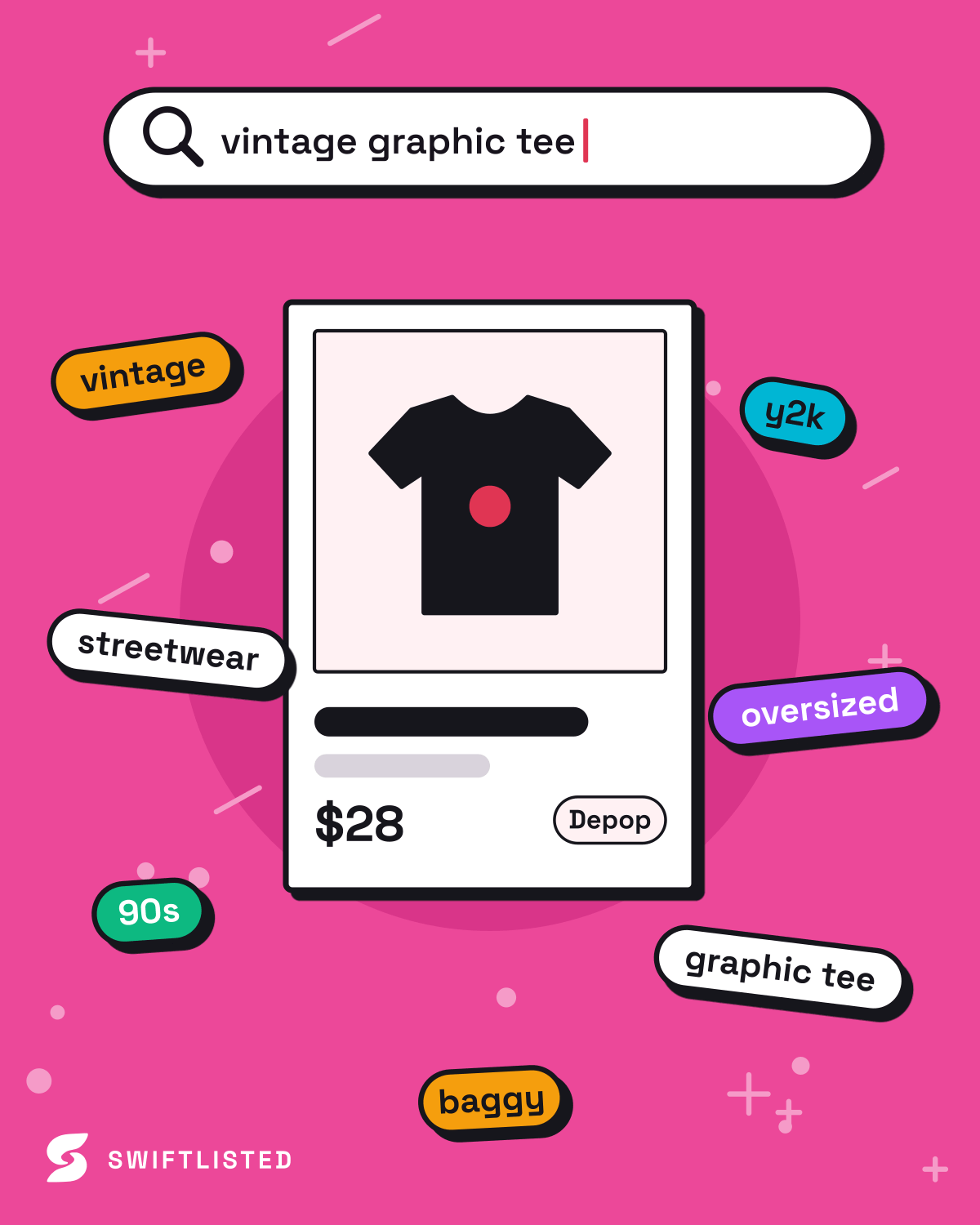
Start with the words a buyer types
Before you write a single title, list the terms a buyer might search for this item. Think in layers: the brand, the specific product name or style, the type of item, the size, the colour, the material, the condition, and the era or fit if it matters. Buyers rarely type all of these, but each one is a door into your listing.
Check what already sells. Search the marketplace for a similar item and look at the titles of listings that have sold rather than the ones still sitting unsold. Note the words repeated across them. Those are the terms buyers are actually using. Be aware that marketplaces change how search ranks listings, so treat what you see as a snapshot and check it again over time.
- Write down the brand, model or style name, item type, size, colour, material and condition.
- Search for a similar item and read the titles of sold listings, not just live ones.
- Note which words repeat across sold listings; these are the buyer's vocabulary.
- Keep a short list of common misspellings only if you have seen buyers make them, not as a guess.
Put the strongest terms in the title
The title does most of the work in search, so it should carry the terms that narrow the search most: brand, item type and the identifying detail. Descriptive filler like 'Amazing', 'Look', 'Rare!!' or 'Must have' adds no searchable words and usually wastes characters. Each marketplace limits title length differently, so check its current limit rather than assuming.
Order matters less than inclusion. A buyer searching 'Levi 501 black' and a buyer searching 'black Levi 501' will both usually find a title containing all three words, but a title that is missing one of them may not appear at all. Make sure the brand, the model and the colour are each present somewhere in the title.
- Lead with brand and item type, then the model or style name and size.
- Include colour and material if they are part of how buyers describe the item.
- Remove words that describe your feelings about the item; buyers do not search for them.
- Do not stuff unrelated brands or trending words that do not describe the item. This can break the marketplace's rules and reads as spam to buyers.
Use the description for everything the title cannot hold
The description is where you add the words the title has no room for: measurements, fabric content, fit, care, the era, the country of manufacture, and the specific wording a buyer might use for a feature. A buyer who searches 'wool blend' or 'relaxed fit' may find your item through the description, depending on how the marketplace indexes text.
Be accurate. Describing a polyester shirt as 'silk' to catch more searches is a misrepresentation, it leads to returns and disputes, and it can get a listing removed. Only use a term if it is true for the item in your hands. Describe flaws plainly too; a buyer who finds a stain you did not mention will leave a poor review, and that hurts future visibility.
- Add measurements in both units if you sell internationally, since buyers search and compare by measurement.
- State material and fibre content exactly as the label says.
- Name the fit, cut or style if it is clear from the item.
- Describe any wear, marks or repairs in plain words, using the terms a buyer would look for.
A worked example
Suppose you have a women's denim jacket, a mid-blue wash, size 10, by a brand you know well. A weak title reads 'Lovely denim jacket, great condition'. It contains only one searchable term, 'denim jacket', and buyers searching for the brand or size will not find it.
A stronger title reads '[Brand] denim jacket women's size 10 mid blue wash'. It names the brand, the item, the audience, the size and the colour. In the description you then add the measurements, the cotton content from the label, that the fit is cropped, and that there is a small mark on the left cuff with a photo. Now the item can be found by a brand search, a size search, a colour search, or a material search, and the buyer who sees it knows exactly what they are getting.
- Weak: 'Lovely denim jacket, great condition'
- Stronger title: '[Brand] denim jacket women's size 10 mid blue wash'
- Description adds: measurements, cotton content from label, cropped fit, cuff mark described and photographed
Repeat the same item across marketplaces with care
If you crosslist the same item to several marketplaces, the keywords are not identical everywhere. Each marketplace has its own search behaviour, its own category tree and its own fields for size and brand. A term that drives traffic on one may be irrelevant on another, and some marketplaces let you fill structured fields that search weights more heavily than free text.
Where you use a crosslisting tool, check each marketplace's version after posting. Confirm the brand and size fields are filled from the structured options rather than only from the description, and that the category is the right one for that marketplace. Automation is useful for speed, but it can fill a field with the closest match rather than the exact one, so a brand mapped to 'Other' or a size converted wrongly will hurt search. Review before you list, and spot-check afterwards.
Swiftlisted is one tool that does this: it drafts the title and description, maps your category to each marketplace, and posts to the marketplaces you choose. It posts from your own signed-in Chrome session, so it works only on a desktop or laptop with the extension installed, and a failed listing is logged rather than silently fixed. You still need to read every draft, because a generated title can miss a term buyers use or add one that is wrong.
- Check that brand and size are filled from each marketplace's structured fields, not just the text.
- Confirm the category is the one buyers browse, not just the nearest match.
- Read every auto-generated title; correct any term that is wrong or missing.
- Spot-check a few listings after posting, since marketplace behaviour changes.
Risks and what lowers them
Keyword work can go wrong in three main ways. The first is over-stuffing: packing a title with every related word makes it hard to read, may breach the marketplace's listing rules, and can lower the listing's standing. Marketplaces set their own rules on this and change them, so check the current policy for each one you sell on rather than relying on what worked last year.
The second is inaccuracy. A term that brings clicks but misdescribes the item produces returns and complaints, which cost more than the extra views are worth. The third is over-reliance on automation. An AI draft, or a tool that fills fields automatically, can be fast and useful, but it can also produce a confident wrong brand, an unusual size, or a title that sounds right and misses the search you needed. Nothing here guarantees you will show up for any given search.
What lowers these risks is simple and not glamorous: write for the buyer, keep every term true, check the structured fields, read each draft before it goes live, and review what has sold and what has not.
- Do not stuff titles; keep them readable and check each marketplace's current rules.
- Use only terms that are true for the item, and describe flaws openly.
- Treat automated drafts as first drafts and correct brand, size and category before listing.
- Review results over time and adjust; there is no fixed formula that works everywhere.
Common questions
- How long should a resale listing title be?
- It depends on the marketplace, and limits change, so check the current maximum on each one you sell on. Within that limit, prioritise the brand, item type, model or style and size, and leave out filler words that buyers do not search for.
- Should I use the same title on every marketplace?
- Often the core words can stay the same, but each marketplace's search and category structure differs. Adjust the wording and check that structured fields like brand and size are filled correctly on each one.
- Do keywords in the description count for search?
- That depends on how each marketplace indexes text, which varies and changes. Include the accurate detail buyers might search for in the description, but do not rely on it alone; the title and structured fields usually matter most.
- Can I use a term I think buyers search for even if it is not quite accurate?
- No. A term that misdescribes the item leads to returns, disputes and possibly removal of the listing. Use only words that are true for the item you are selling.
- Does a crosslisting tool choose the right keywords for me?
- It can draft a title and description and map your category and fields, which saves time. But it can produce a confident error, so read every draft and check the brand, size and category before listing. The plans and what each includes are on the pricing page at swiftlisted.ai.
List once, sell everywhere
Swiftlisted photographs, describes and crosslists your stock across every marketplace you sell on — then delists it everywhere when it sells.
Start free trial